|
Rational or
Experimental or
Opportunistic
Corporate or
Business Unit or
Department
Life Cycle
External Assessment
What is the Demand?
Internal Assessment
How Well Do We Supply?
Sustainability
Strategic Focus
Strategy Maps |
Strategy Maps - Market Opportunities
Clayton Christensen is expert at making complex opportunities easier to spot.
Both the BSC and mapping profitable market opportunities are being taught to new MBAs.
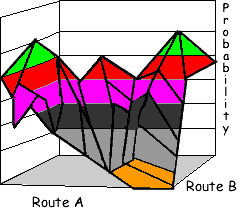
The Business Landscape
Ghemawat focuses on the key players, the demand - supply problem and then, models the landscape to analyze options to predict peaks - the best outcomes. You would position your business to reach the highest peak. The mathematical analogy is linear programming, and the example above is well beyond most of our capabilities to produce. But, the method is straight forward.
The steps are:
- Identify the players and establish the boundaries. Where do buyers, suppliers, competitors and complementors co-exist? Include indirect competitors that offer products or services that are close substitutes and new or potential ones. Be detailed: across product markets, along the supplier and buyer channels and across local, regional, and national boundaries. Describe the financial opportunity and your performance compared to your industry average.
- Map the key relationships and their decision role. Be detailed about their information. requirements. Include both competitive and complementary relationships.
- Shape the landscape. Prioritize the players and influences relationships.
As a facilitator, I use Brandenburger and Nalebuff's Value Net to map these relationships and Christensen's approach to anticipate the growth opportunities, which I introduce in the Research Chapter. It is easier to explain.
 Balanced Score Card
 |
|
Approaches

|
|
