|
The Basics
Discounting
Net Present Value
Terminal Value
Value Added
The Decisions
Discount Rate
Hurdle Rate
Weighted Average Cost of Capital
(WACC)
The Math
Estimate Terminal
Value
Annuity Method
Market Value/Sales
Compare Methods
DCF Key Questions
Combine Action Plans
Key Points
|
A Strategy's Value
Key points
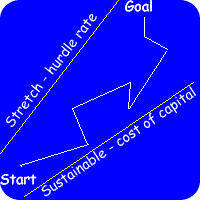 The five fundamental questions to determine a strategy's value are: The five fundamental questions to determine a strategy's value are:
- what is the benefit to the customer, our promise to the customer?
- how are we going to pay for it - what is it going to cost?
- who is going to do this - are we able to do this?
- is the timing right? Our competitor's response?
- what is the bottom line to our firm?
In this chapter, we examined how to estimate the value added to the
bottom line. Using the Action
Plan page templates, our
key players map out what is it going to cost, the timing, who is going
to do it.
From the Page
2 Template, they then combine all the action plans
NPVs of the growth phase and PV of the terminal values to calculate
the strategy's
total
value
added. All this work is a rehearsal, a road map, a model of the strategy.
Key points
- the senior management team when they select the discount rate are
setting the desired pace, the desired return, the stretch.
- Keep the inputs simple to the NPV and Terminal Value calculations,
so you can compare one alternative to the other. Do not let folks adjust
the basic formula!
- One person needs to review the financial analyses for consistency
and rigorousness. In my experience, that is the only way to compare
"apples to apples."
- The analyses provided to investors and lenders should be calculated using
methods they trust. This may be very different and more complex than the
calculations used internally.
 Combine action plans
 |
|
Key Documents

|
|
