|
Making
Comparisons:
How
Far to Drill Down
Quantitative data
Relative data
Presenting
Data
Models:
Macro Trends
Porter's Competive Forces
Complementors
Value Chain
Value Proposition:
Customer-Product Match
The Buying Decision
Importance-Performance
Matrix
I/P Matrix Variations
Your Employees
Financials:
Corporate
Business Unit
Department
Who Does The Research |
Michael E. Porter - The Value Chain
Michael Porter's defined the value chain. It is the theory that underlies activity based management and ultimately, Norton and Kaplan's Balanced scorecard. By analyzing the process flow through business, identifying the critical success factors for the key processes, where value is added to the firm, measuring that and mapping it onto a balanced scorecard, setting targets and emphasizing the key processes, a strategic planning team can focus and align the entire organization. Porter's body of work is a fundamental influence on strategy formulation, the subject of this online book.
Using a manufacturing template, he identifies primary and support activities. The primary activities produce the product or service for the customer as it moves through the firm, inbound logistics, operations, out-bound logistics, marketing and after-sale service. Support activities provide the firm-wide infrastructure for the primary activities including procurement, technology development, human resource management, and firm infrastructure, i.e., the front office.
The value chain is a horizontal look at a firm with a process - product perspective versus a department view of the firm used for the budget.
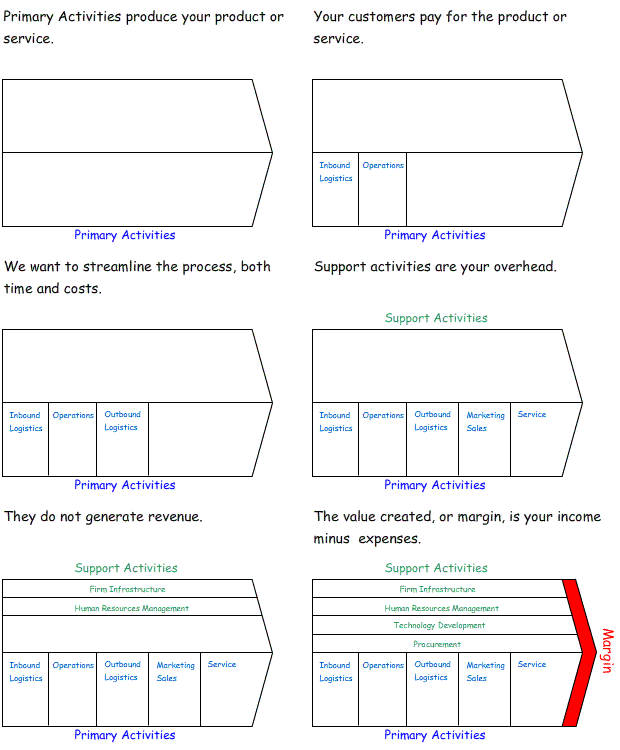 A firm's purpose is to create value for its owners, and activities that increase value are deemed valued added. To optimize or 're-engineer' the firm, management should eliminate or reduce the non-value added activities and improve the processes of the value added ones. This is a cost containment, alignment tool on the supply side of strategy formulation. A firm's purpose is to create value for its owners, and activities that increase value are deemed valued added. To optimize or 're-engineer' the firm, management should eliminate or reduce the non-value added activities and improve the processes of the value added ones. This is a cost containment, alignment tool on the supply side of strategy formulation.
The problem with value chain analysis has been and continues to be how to measure activities across the firm rather than within department budgets. Traditional accounting systems do not do that well.
Activity based management
Many firms today have changed or integrated their information management systems to capture both department budgets and accounting for the processes goods and services follow through the firm. The latter is called Activity Based Management. Sounds easy, but it is not. It requires a significant investment in measurement processes, software, tracking hardware and training - a huge strategic decision in itself. Firms that master ABM have a significant competitive advantage.
Once you have Activity Based Management data, you can continuously fine tune your costs to work the supply side. You also have a significant advantage planning big, long-range process improvements.
 Often, I find my clients do not identify with Porter's original value chain because it uses a manufacturing template. In response, Porter in many articles, like his Harvard Business Review article on "Strategy and the Internet" (March 2001), extended the manufacturing value chain model to other industries. Often, I find my clients do not identify with Porter's original value chain because it uses a manufacturing template. In response, Porter in many articles, like his Harvard Business Review article on "Strategy and the Internet" (March 2001), extended the manufacturing value chain model to other industries.
 Complementors Complementors |
|
Other Value Chains  |
|
